
I struggled with deciding what my topic for this month’s Reflections on the Fox should be, not because there wasn’t enough to write about, but because there is too much! Should I write about the Peregrine Falcons nesting along the Fox River in Aurora or should I write about the Bald Eagle nesting season that’s in full swing in the Fox River Watershed? Alternatively, I could write about my favorite pastime in this part of spring, finding and photographing warblers and other colorful birds that are migrating back to our area or further north as spring picks up momentum. I ultimately decided: why choose one over another when I can write about all of them? After all, I’ve observed all of the types of birds I mentioned above over the last three-day period (April 12-14, 2026)! They will also be around for at least the next month, so it’s a timely and reasonable thing to do.
Nesting Raptors
Peregrine Falcons
One of my more exciting pastimes in the last few weeks has been observing the pair of Peregrine Falcons that live in Aurora, courting and then nesting along the Fox River. These birds are fascinating as they are the fastest animal that ever lived on Earth (able to achieve speeds in excess of 240 mph in a stoop) and they are spectacularly beautiful! The Aurora pair, named Dave and Vixen, have been nesting here for the last five years in a nest box atop the old Leland Hotel.


This year, they have chosen a different nesting site, but one that makes them at least as visible to a sharp-eyed observer than their previous site on the old hotel. I’m hoping to have more exciting news to share about these beautiful birds in next month’s Reflections article, but for now, here’s a picture of both Dave and Vixen. These photos of Dave and Vixen were taken on Monday, April 13 in Aurora over the Fox River.
Bald Eagles
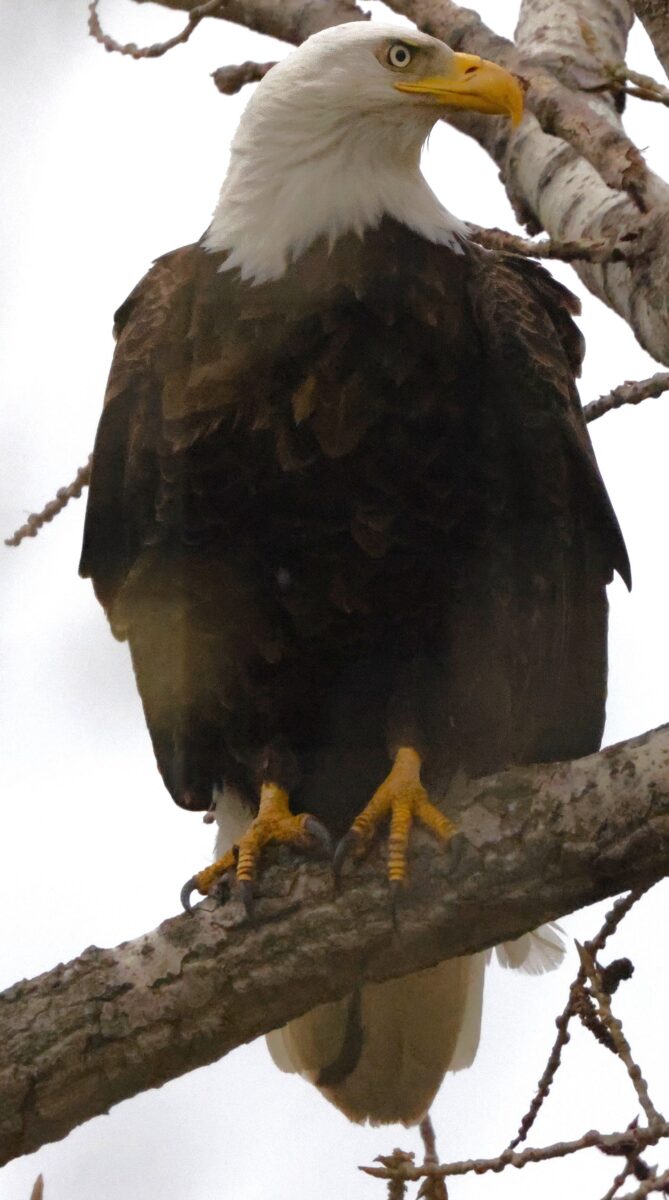
There are at least six nesting pairs of Bald Eagles within ten miles of my house located in the Fox River Watershed between Aurora and Sugar Grove. As of this writing, one nest has eaglets that are already approaching four weeks old and most of the others have hatchlings significantly younger than that.


Over the years, Bald Eagles have become a more and more common sight in our watershed and the nesting pairs are doing their part to sustain that population! They are really fun to observe and photograph.
Over the last three-day period, I have seen and photographed four of the nests and seven different individual adult Bald Eagles along with one subadult!

One of the adults that I have photographed (Clyde, from the Eldamain Road bridge nest) has caught a fish on two different occasions to take back to his eaglets in the nest. His first catch was a white sucker and his second was a fairly good-sized white bass!
On a side note, the fishing in the Fox River is picking up for human anglers too now!) If things go according to plan, the eaglets in our local nests should all begin to fledge around the Fourth of July. Another exciting time to be birding!
Osprey

While I don’t know of any Osprey nesting in our watershed at this time, I did photograph my first of the season over the Fox River at the Hoover Forest Preserve this afternoon (Tuesday, April 14). It was an adult male flying downstream over the Fox River probably just looking for fish, but maybe looking for a mate and nesting site as well. They are one of my favorite birds and are spectacularly good fishers! They are amazing to watch dive from a hover into the water and emerge with a fish.
Their only trouble after catching a fish is keeping it away from the Bald Eagles who will gladly steal it from them! I’ve watched this happen on numerous occasions along our Fox River in Kendall County and it provides some moments of drama. I occasionally see an Osprey get away from the eagles without giving up the fish, but that’s rare. Once an eagle decides it wants the Osprey’s fish, they most often get it. I’ve never seen an eagle injure an Osprey as it pursues them for the fish, though.
Smaller Birds Returning to or Migrating through the Watershed from their Winter Respite in the South
Over the last few days, I’ve seen a large number of Yellow-rumped Warblers in their beautiful breeding colors in the Hoover Forest Preserve along the banks of our Fox River. They will be followed by many more species of warblers that are returning to or migrating through our area.


Other returning migrants I’ve photographed over the last few days include Ruby-crowned and Golde Crowned Kinglets, Eastern Phoebes, a few different species of Sparrow, American Goldfinch, and one of my favorite little birds with a strong personality, Blue-grey Gnatcatchers. Other birds like Northern Cardinals, American Robins, and Carolina Wrens that have somewhat stayed in the area over the winter are becoming more active and singing loudly in the woods.


It’s truly a great time to be outside somewhere in our Fox River Watershed to enjoy nature awakening from its winter slumber. The ephemeral wildflowers are beginning to bloom, the leaves are quickly emerging in the warm weather, the fish are becoming active, and the birds are really showing up everywhere!


As I’ve highlighted, all the birds that are pictured in this article were photographed within the Fox River Watershed over the three-day period between April 12 and April 14. If you have the time to get outside for a couple of hours, try to get to one of your favorite natural spots and just sit and watch for a while. Just being outside in nature is relaxing and rejuvenating and, at this time of the year, you never know what you might see!
Until next time, Keep On Fixin’ the Fox!
All photos were taken by Tom Schrader