My husband and I moved to Kane County because of the Fox River. We wanted to live near this vibrant living being. This summer when my grandson spent a week at a Kane County Forest Preserve Camp that met in Jon J. Duerr Forest Preserve, I stayed every day while he was at camp. So I communed with the river for 15 hours in one week. I’ve hiked that section of the Fox River Trail many times, but for these five days I hiked and then did my nature journaling. Nature Journaling is a practice that helps me become fully present. It’s not at all like walking through a place. Now that I’ve learned to notice, I see more, and I have more questions. That all makes a place more interesting, and as my curiosity builds, I become more interested. Nature journaling in a place repeatedly has that effect–intense curiosity and interest.
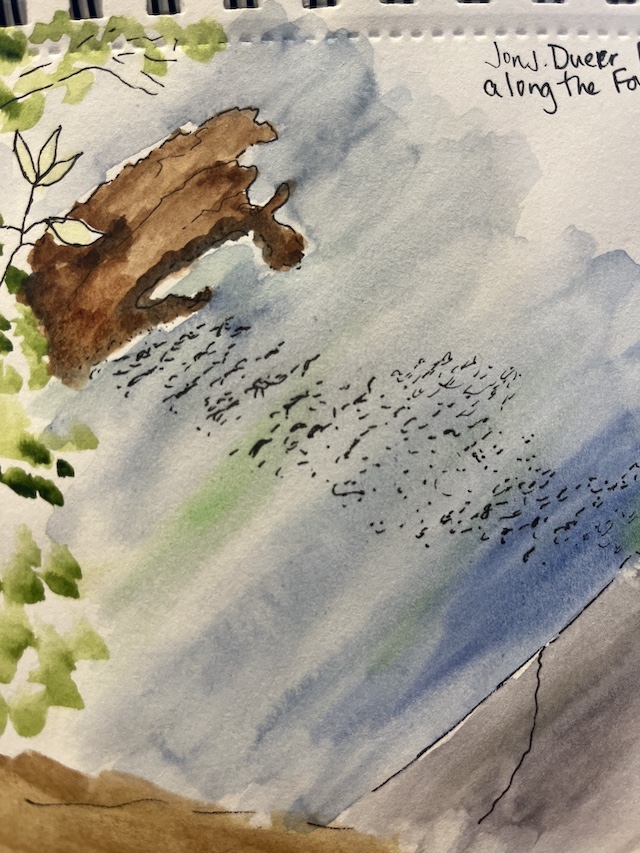
I found a great place to watch the river right at the end of a paved path near a shelter. I set up my three-legged stool and took some deep breaths. I saw a large gathering of boater insects all downstream of a fallen log. Every day I checked, and every day the bugs were scooting around the water. Once I noted that a large bug landed near the boaters, and they all swiftly moved away from that bug. Despite lots of fish swimming nearby, the number of boaters did not seem to diminish. On the other side of my spot, a mulberry tree’s branches were hanging over the water. Every day four or five huge fish showed up under that tree at about the same time. The water became so shallow that their backs showed above it, and they seemed to be eating the fallen mulberries.
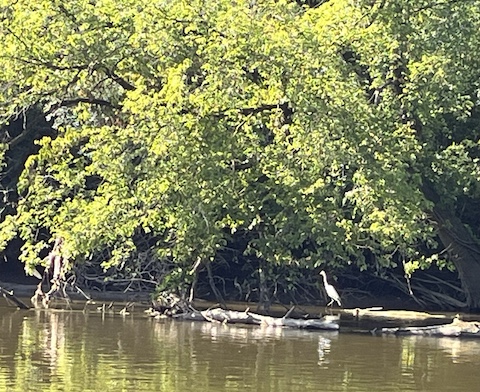
On two mornings, I watched a great white egret search for food along the shoreline of the nearby island. Her elegant thin feathers made her seem luminescent as she stalked along. I saw a wide variety of small fish near me. Were they in the shallows for protection? Was food available in that location because of some small eddies? Why did those tiny and small fish hang out near a piece of cement stuck into the river where I was sitting?
Blue, green and brown dragonflies and damselflies flitted around every day. I used a variety of verbs to describe their movements: flit, dodge, swerve, circle, hover, dart. They seemed to be curious about me, often hovering opposite me, staring me down. When a steady breeze appeared, they moved horizontally but not up and down. Their wings seem to be made to make some kinds of movements but not others, and as I spend more time along the river, I want to study them more carefully. I should read more of Cindy Crosby’s work like Chasing Dragonflies: A Natural, Cultural and Personal History.
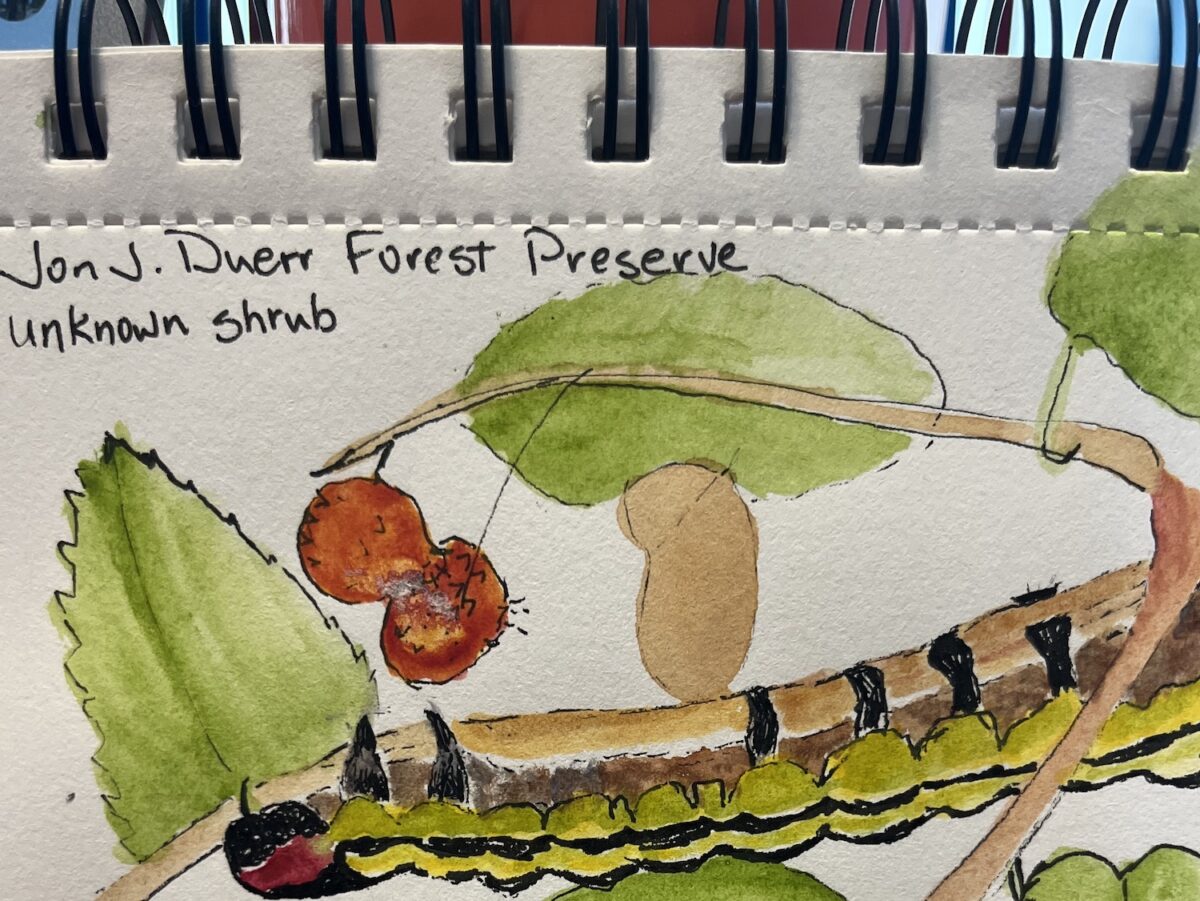
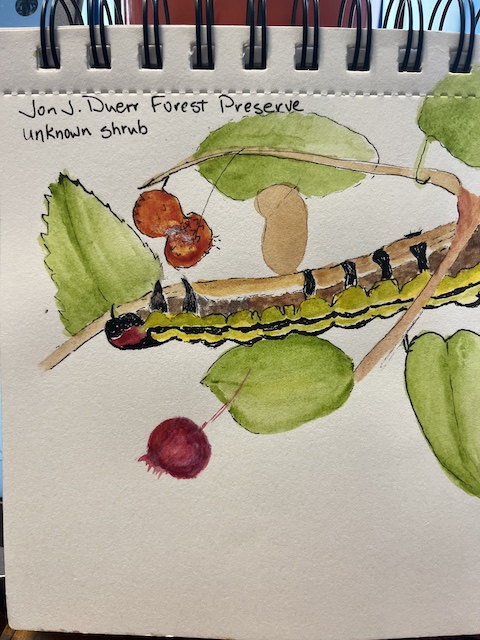
On my way to the shelter, I stopped by a bush with berries or seedpods. This winter I watched The Extraordinary Caterpillar by Merit Motion Pictures and Homegrown National Parks, and I was hoping to be lucky enough to see some caterpillars in real life this summer, and I did! I was attracted to this bush because it has orange/magenta fruits that were spiky and the bush’s multiple trunks. I was studying the fruit when the caterpillar munched his way into my sight line. I immediately took out my phone and got a photo because I wasn’t going to miss this chance to get him identified. iNaturalist confirmed that “my ” caterpillar was a Radcliffe’s Dagger which will grow up to be the kind of moth we see at dusk. He was hanging upside down there every subsequent day, and about one leaf a day disappeared.
On my fourth and fifth days on the river, my granddaughter hung out with me for the whole time her brother was at camp. The first thing we did each day was check on the boater bugs in the water. They didn’t seem to decrease in number. Then we waited for the big fish to come eat the mulberries. While the camp kids were still under their shelter we walked to Tekakwitha woods, so she could see more of her brother’s “classroom.” On our last day, a tree was blocking the path that ran parallel to the river. When we looked more closely we saw that the tree had been felled by a beaver. Of course, that was the day I left my phone in the car, but we saw the pointed top of the stump. That was something I had never seen in person, so I was really excited.
As we walked back to Duerr FP, my granddaughter spotted a deer coming down a path in the forest. We stopped on the bridge to watch it, and it walked right under us. When we started walking, a board on the bridge shook a little and the deer scampered downstream. I have never been that close to a deer in the wild until now. We were incredibly lucky to see those things. Learning to look closely and ask questions like, “What made that tree fall down?” helps me see more things.
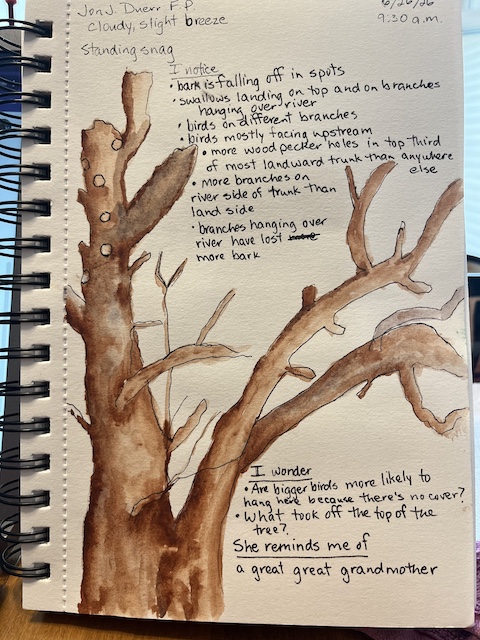
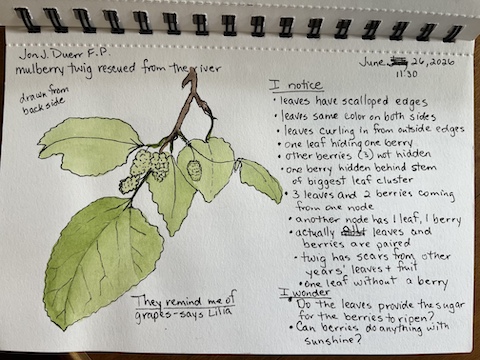
On our last day, we sat at the kayak launch/fishing spot. I studied a dead tree standing along the river, and my granddaughter nature journaled about a mulberry branch that we fished out of the water. Both were fascinating. When she was done looking at the mulberry branch, I decided to turn it over and study it from the underside while she created some watercolor paintings. I discovered that every berry has a leaf to protect it. I wonder if that leaf is what provides the sugar that ripens the berry. I could look it up, but I prefer to think about what I’ve observed in other fruits and to use that question as I study the blackberries I’m growing in my back yard.
I have taught my grandkids to say hello to the river when we cross over on our way to my house and to say goodbye when we are on our way back to their house. Recently I listened to Robert Macfarlane’s book Is a River Alive, and I like to treat the river as if it were alive. My respect for the river and the land around it grows as I discover more and more through nature journaling.
Nature journaling can serve your purposes, and it will make you calmer and more satisfied. Nature journaling is helping me become an artist by helping me see things I used to overlook. It’s helping me become a naturalist by raising questions. These questions lead me to read books or parts of books, listen to podcasts and talks and ask even better questions. The thing I like best about nature journaling is how I feel when I’m doing it, even when I’m doing it with a child who needs some attention. When I am focused on doing just one thing, I relax into doing that one thing. I find a sense of flow, of peace. I want everyone to be able to find that feeling.